
Why Do Bad Things Happen to Good People? (Part 1)
Have you ever wondered- why do bad things happen to ‘good’ people? This is one of the most frequently asked philosophical questions…So what does the Bible say?
What we can learn from The Old Testament about why bad things happen to good people
This is the first in a four part series on what the Bible says about why bad things happen to ‘good’ people.
Have you ever wondered- why do bad things happen to ‘good’ people? This is one of the most frequently asked philosophical questions of all time. It’s been searched millions of times on Google sites. It’s been called one of the most important questions Christians must answer. And there are solid theological responses from well known Bible scholars throughout history. So why do we keep asking it? This question is so common and so important that it will take more than one post to look at what The Bible says that offers true hope.
Sometimes this question is asked abstractly. Somewhat generally- almost as a thought experiment. But often, when it’s asked, it’s not theoretical, it’s practical. It’s asked from a place of pain. It’s asked when something difficult happens to us or someone we love. Something unusually hard. Something they don’t seem to deserve. It's often coming from a place of wanting a way for the pain to end. Wanting relief. Sometimes people even blame themselves superstitiously or they are blamed by others who misunderstand what the Bible says about suffering.
The responses to this question are often cliche, quick statements people grab when they don’t know what to say. Things like ‘God never puts more on us than we can bear.’ The challenge is that they aren’t always true. They are just common. ‘God never puts more on us…’, for example, isn’t in the Bible the way people apply it. It’s a misinterpretation of 1 Corinthians 10:13- which is actually talking about temptation, not about enduring painful circumstances.
No temptation has overtaken you that is not common to man. God is faithful, and he will not let you be tempted beyond your ability, but with the temptation he will also provide the way of escape, that you may be able to endure it. 1 Corinthians 10:13 (ESV)
So then what does The Bible actually say about why bad things happen to ‘good’ people? And how can there be hope in situations that are so painful? In order to understand what The Bible has to say about this, it’s helpful to look at both the Old Testament and the New Testament. In today’s article, we’ll take a look at what we can learn from The Old Testament about why bad things happen to good people.
One of the things that happens in the Old Testament, is that God gives His people the rules, the 10 Commandments and more, for how He wants them to live. Along with these rules, He explains the incentives and the disincentives for obeying and disobeying. There will be blessings if the people obey and there will be painful consequences if they choose to disobey. Lots of times when people misunderstand why bad things happen, it’s because they stop here. They understand how to follow rules, and they think this is the only factor at play.
This kind of Old Testament justice seems to make sense to us. It feels fair- especially when we are the ones being harmed. Instinctively, many of us feel like we would be perfectly willing to take this deal! After all, it provides the feeling of control in a world that can feel chaotic and scary. If all we have to do is follow the rules and we have happy lives, that sounds great!
The problem is, when we dig deeper into God’s word, there seems to be more complexity. We see examples in the Old Testament that hint to us that the formula for happily ever after isn’t as simple as it may have seemed at first. For example we see:
- Abel, the obedient, ‘good’ brother. The brother who pleases God, is killed by Cain. There are consequences for Cain, but these do not bring back Abel’s life. From Abel’s perspective he was ‘good’ and then received evil and died.
- Joseph is ‘good’ and chooses to honor God when tempted by Potiphar’s wife. He won’t lie with her, but she lies about him and he is then thrown into prison.
- Job is perhaps the clearest example. God actually allows painful circumstances in his life, precisely because he is so comparatively ‘good’. And we see the people around him blame him for his suffering, using this same overly simplistic formula that is so often used today- Bad things are happening to you, so you must have done something bad.
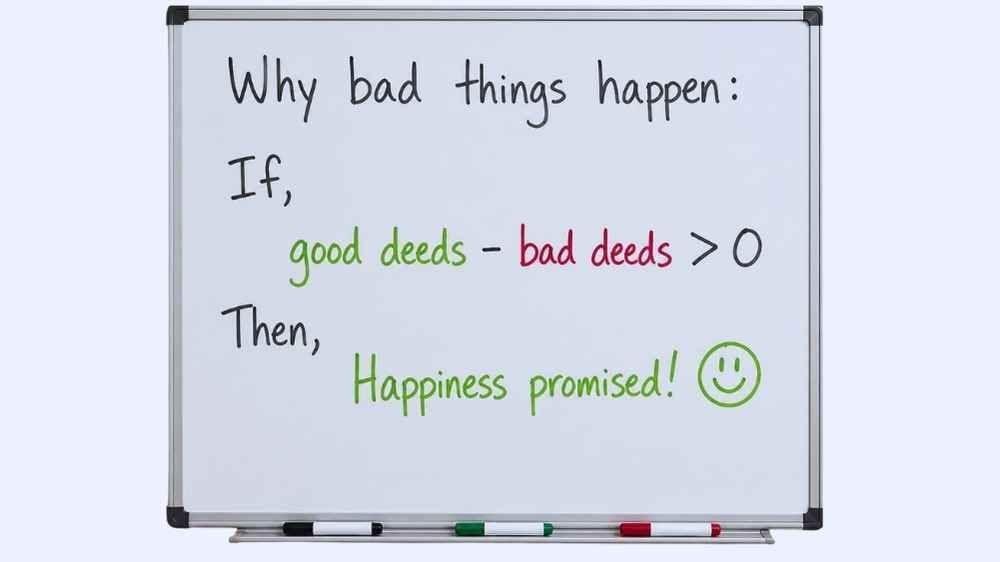
So when we ask the question, ‘why do bad things happen to good people?’ - part of what seems so wrong to us, is that we assume the formula for having bad things happen is really simple, like arithmetic. As long as our good deeds outweigh our bad deeds, we’re good! Happily ever after, guaranteed! Like points in a video game or a pickleball match. As long as we gain more than we lose- we win!
We think the formula is:
If,
good deeds - bad deeds > 0
Then,
Happiness promised!
Else,
Bad things happen.
But, we need to look at this formula more closely. Is it accurate? If we were testing it as a theorem, we’d have to admit that it doesn’t seem to account for cases like Abel, Joe, or Job. If things are that simple, the formula should always work. But if we find examples where the math isn’t mathing, we need to dig deeper to understand what God is showing us.
This is important because trying to use a simplistic formula is harmful in ways we might not realize. It’s like trying to send a rocket to the moon with the math of counting on our fingers. Dangerous. It can cause us to heap more pain on people who are suffering, by blaming them. Like Job’s friends, we may add insult to the already injured. It can also set us up for crushing disillusionment when disproportionately hard things happen in our own lives or in the lives of our loved ones.
Believing in a simplistic, inaccurate formula is also what sets us up for the feeling of ‘how could this happen to me?’. Even for feeling like we don’t know if we can trust God. If we don’t understand what He’s promised and what is just cliche, we feel let down if life doesn’t work the way we thought it would. The issue though is not that God broke His promise, it’s that we didn’t understand the promises in the first place. It turns out the formula for ‘why bad things happen to good people’ is less like arithmetic and more like multivariate calculus.
Because this is such a complex question, this article will be the first in a four part series over the next several weeks digging deep in God’s Word to understand what He has promised. The good news is, there are real answers to this difficult question. And they do provide true hope! If you stop in the Old Testament, though, things do look bleak. But in Part 2 of this series, we’ll take a look at how Jesus changes everything about why bad things happen.
Part 2- How Jesus changes everything about why bad things happen to good people
Part 3- What the Bible has to say about goodness
Part 4- Why is it important for Christians to understand why bad things happen to good people
If you are going through something painful right now, I hope that you will be encouraged that Jesus cares. He loves you. And He is the essence of True Hope. If you’d like to know as soon as a new article is posted, you can join the email list here. If you find this work helpful and would like to support, you can learn more here.
Thank you for reading.
This article was written by a real person, me 🙂, not AI.
For true hope and joy,
~m